
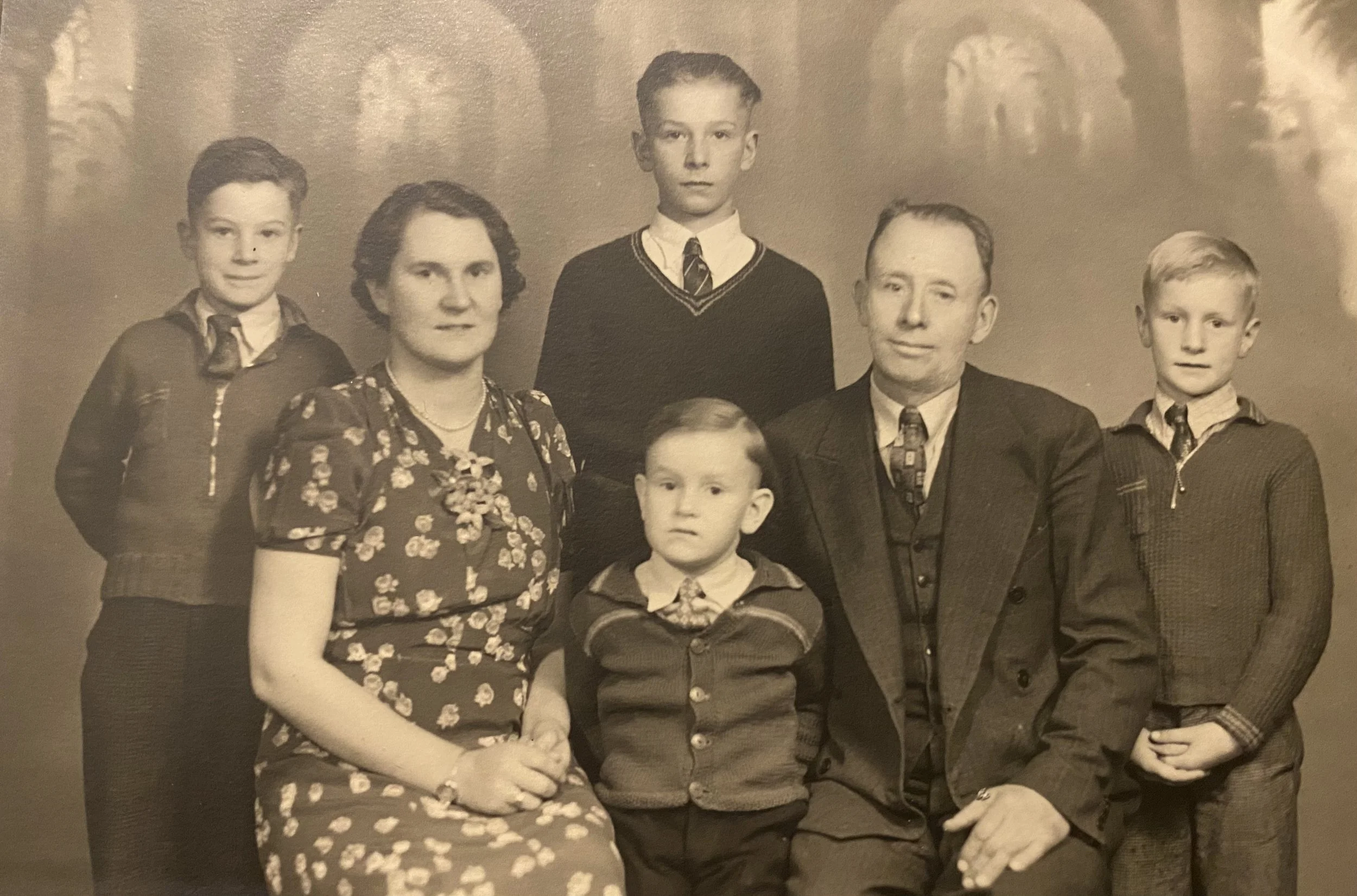
A family Reunited
Meet the Four Boys
Let me introduce you to the family.
These were the four beautiful boys at the heart of Martha's story. Kenneth (Soren in the novel) was the eldest, born in 1929, followed by Roger (Carl) in 1931, Roland (James) in 1932, and finally David (Jonathon) in 1935.
When Martha entered the sanatorium in 1935, Ken was barely six, and Roland, the youngest of the three boys at home, was only two. David would be born while she was there.
It is unimaginable to me to have to leave your children because of a disease, yet this was the reality for so many families affected by tuberculosis throughout Canada and the United States in the late 1800s and early 1900s.
My dad was the second oldest — Roger.
The four boys had several things in common — their willowy, lean builds growing up, their fair complexions and their quiet, good manners. Beyond that, as in many families, their personalities were quite different.
Kenneth
Ken was viewed with a certain amount of awe by his younger brothers. He was physically strong, did well in school and was an incredible baseball player.
I don't know a great deal about my Uncle Ken, but I do know that he graduated from the University of Saskatchewan, became a captain in the Canadian Air Force and flew planes for over 20 years.
He married and had five children. Growing up, I remember visiting them in Edmonton, but they also lived in New Zealand for quite a few years. I wish I knew more about their family's adventures. What I do remember is that my four male cousins were incredibly handsome, and their sister was both stunning and extremely adventurous!
Roger
Roger, my dad, was not only well-liked by everyone but was equally helpful to his dad on the farm and his mother in the kitchen.
According to his younger brother, he was the first to rise in the morning, always cheerful, enthusiastic and ready to help wherever needed. Once one chore was completed, he would ask what else he could do. He was also an excellent athlete and loved playing baseball.
Like his older brother, he attended the University of Saskatchewan, where he received his degree in agronomy. He worked for Massey Ferguson and later became a farm writer, interviewing farmers across the Prairies and writing and editing Grainews, a popular and widely read agricultural publication.
He married and had four children, of whom I am his only daughter. Although he lived in the city, his love for the farm never ended.
Of the four boys, I believe he was most like his dad — kind, caring, generous and always cheerful.
Growing up as his daughter, I couldn't imagine having a better father. He would come home after a day of work and spend time playing with us kids. In the summer, we would be outside playing baseball on the street, or we would be snuggled on his knee while he read us the comics from the newspaper.
Family was so important to him. He was also always willing to help my mom in the kitchen, preparing meals and doing dishes — something that wasn't particularly common for men of his generation.
Roland
Roland also attended university, earning degrees in arts and education. He married, has seven children and, now in his 90s, is still creating and teaching art in his studio!
When I was a teenager, I attended Western Christian College in Saskatchewan. My uncle was a teacher there and was the very reason I wanted to attend.
He and his wife, Lois, are both incredibly talented artists. You can see their paintings on my website, depicting the homestead where Martha and Robert raised their boys.
They are also wonderfully gracious hosts. People come from all over to visit their home and studio and see their artwork, and there is always a cup of coffee or a meal to share.
Growing up, Roland apparently had quite a temper, but he was also extremely creative. According to his younger brother, he made toy airplanes, boats, skis and eventually a crossbow that could shoot a metal arrow with considerable force.
I remember my dad telling me stories about those bows and arrows and the games of cowboys and Indians they played as young boys. Thankfully, the arrows were heavy and didn't quite hit their intended targets, or those childhood adventures might have had a very different ending! 😂
David
David, the youngest, was born in the sanatorium and spent five years being raised — and apparently quite spoiled — by his grandmother. He had just turned six when he returned to live with his family on the farm.
According to his own recollections in his book, A Mind in the Making (available on Amazon and a very interesting read), he was regarded by his older brothers as somewhat exotic and hopelessly spoiled.
When he joined his family on the farm, he was astonished that he wasn't always given his way, appalled that he was expected to help with chores and considered rather lazy by his older brothers.
David went on to have a remarkable academic career. He attended the University of Saskatchewan, became a teacher, and continued his education at the University of Alberta and eventually graduate school.
He became a child psychologist, spending many years studying how children learn and developing the role of school in their development. His work took him around the world, where he studied, conducted research and was invited to speak. Over the course of his career, he received numerous academic honours and research grants.
He married and has five children. He has also written and published 20 books and 300 articles exploring children's minds and the role of schooling in their development.
He is now retired and holds the title of University Professor Emeritus at the University of Toronto and is a Fellow of the Royal Society of Canada.
A Mother's Dream for Her Boys
So, these are the four boys who made up Martha and Robert's family — four little boys who grew up on a Saskatchewan farm, each with his own unique personality, gifts and dreams.
At their mother's insistence, all four received a university education. Martha knew how difficult life on the farm could be, and she wanted her boys to have opportunities beyond it.
As I reflect on their lives, I can't help but think about that young mother lying in a sanatorium bed in 1935, separated from her little boys and wondering what the future might hold for them.
Could she ever have imagined the lives they would go on to live, the families they would raise or the people whose lives they would touch?
I wonder if she knew, even then, just how much of an influence she would have on the generations that followed.
These were the little boys you met in When Time Stood Still.
And one of them, I was blessed to call Dad.❤️
Discover the Story Behind Their Childhood
You now know what became of Martha's four little boys. But what was life like for their mother during those difficult years of separation?
Inspired by my grandmother's life, When Time Stood Still is a story of family, faith, sacrifice, resilience and hope.
Step back in time to the Saskatchewan Prairies during the Great Depression and experience Martha's journey.
Available in paperback and Kindle on Amazon — a meaningful read for yourself or a thoughtful Christmas gift for someone who loves historical fiction.
Stay Connected
I'd love to have you join me.
Sign up to receive my latest stories, simple wellness inspiration, and a little encouragement for living well along the way.
From Wellness Wednesday and Future Self Friday to our adventures renovating and living in an old school, with the Monday at the Old School Series, you'll find a little bit of everything here.
Come along for the journey. ❤️
